
The High-Stakes Tech Evolution in the Riau Islands' Industrial Hub
Batam is no longer just competing with Cikarang; it is locking horns with the industrial giants of Haiphong and Johor Bahru for dominance in the global supply chain. The year 2025 marks a definitive turning point where operational efficiency is no longer a quarterly target, but a prerequisite for survival in a volatile market. Have you ever envisioned a production line capable of 'sensing' a component failure before it actually occurs? In the industrial zones of Mukakuning and Batam Centre, this vision is shifting from science fiction to the new standard, driven by the next wave of industrial automation.
1. The Ascendance of Collaborative Robots (Cobots) in Precision Assembly
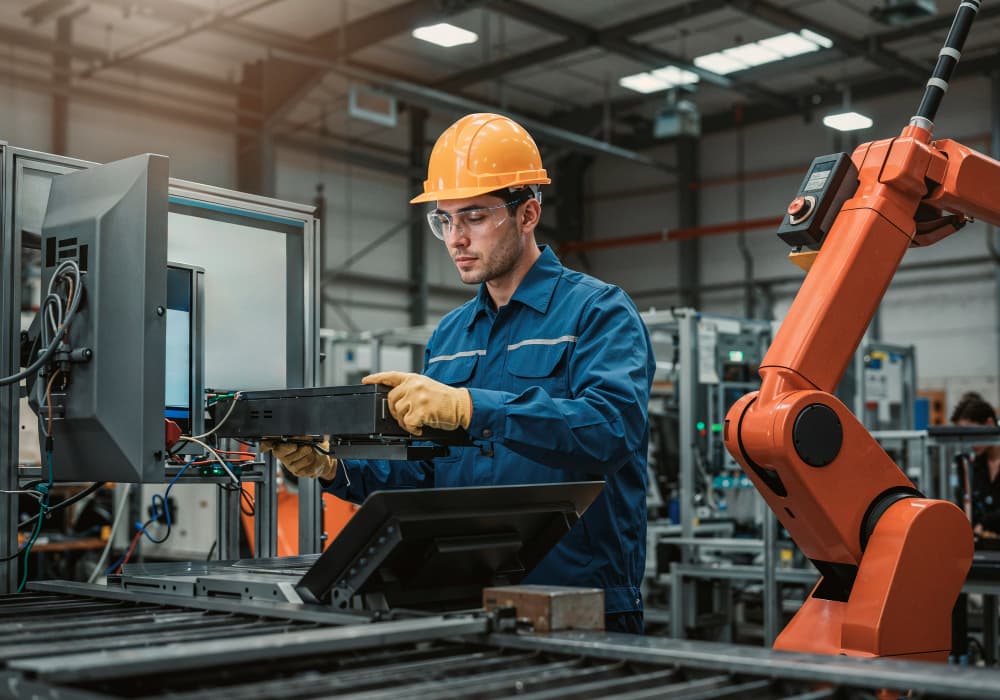
If a decade ago industrial robots were synonymous with massive machines caged behind safety fences, 2025 brings the era of Collaborative Robots (Cobots) that work seamlessly alongside human operators. According to the latest reports from the International Federation of Robotics (IFR), the adoption of Cobots in Southeast Asia is projected to grow by 15% annually. Why is this so relevant for electronics factories in Batam?
The answer lies in flexibility. Modern Cobots are now equipped with advanced haptic sensors, allowing them to perform micro-assembly tasks with micron-level precision. Imagine a scenario where a robot handles the intricate soldering of PCB components while a human worker focuses on visual quality control and strategic decision-making. This synergy not only boosts output by up to 40% but also drastically reduces workplace injury risks that often plague traditional manufacturing environments. It is not about replacing humans; it is about augmenting their potential.
2. AI-Driven Predictive Maintenance: Ending the Era of Unplanned Downtime
Downtime is the ultimate enemy of profitability. Industry statistics reveal that the average manufacturing plant loses up to $50,000 per hour due to unplanned machine failures. In 2025, the trend is shifting from reactive maintenance to Predictive Maintenance (PdM), powered by Artificial Intelligence (AI) and IoT sensors. Isn't it more efficient if your electric motor 'notifies' the technical team that it will malfunction within the next 72 hours?
By integrating vibration sensors and thermal analysis on critical machinery, modern automation systems can detect even the slightest anomalies in operational patterns. This data is processed in real-time to provide actionable insights. For companies in Batam operating CNC machines or plastic injection lines 24/7, implementing this technology means extending asset life by 20% and significantly reducing emergency repair costs. It’s no longer about fixing what is broken; it’s about ensuring nothing breaks in the first place.
3. Horizontal Integration: Bridging the Gap Between IT and OT
A wide chasm often exists between the data generated on the factory floor (Operational Technology/OT) and the data managed by the leadership team in the headquarters (Information Technology/IT). 2025 demands total integration. Industrial Automation trends are moving toward systems that communicate seamlessly, where Programmable Logic Controllers (PLC) do more than just move machines—they send production data directly to ERP (Enterprise Resource Planning) systems.
The question is: How quickly can you respond to changing market demands? With horizontal integration, when an order is placed through the sales system, production instructions can automatically adjust schedules on the factory floor without slow manual intervention. Research from McKinsey & Company suggests that companies successfully integrating IT and OT data both vertically and horizontally can improve time-to-market by up to 30%. This is the competitive edge that separates industry leaders from those merely following the tide.
4. Green Automation: Towards Sustainable Manufacturing
Increasingly stringent global environmental regulations, especially from export markets like the European Union, are forcing industries in Batam to rethink their carbon footprint. Industrial automation in 2025 is not just about speed; it is about energy efficiency. The use of Smart Power Management Systems in automation allows machines to operate in energy-saving modes during idle periods without affecting startup times.
Furthermore, automated control systems that optimize raw material usage can reduce production waste to a minimum. Data shows that implementing smart control systems on industrial chillers and air compressors can save up to 25% in electricity consumption. Amid rising global energy tariffs, this move is not only a form of environmental responsibility but a very concrete cost-saving strategy that directly impacts a company's bottom line.
Conclusion: The Future Belongs to the Adaptable
Batam’s manufacturing landscape is undergoing a massive metamorphosis. The automation trends of 2025—ranging from collaborative robotics to cross-departmental data integration—offer a golden opportunity for companies to leapfrog ahead in the global value chain. However, this transition does not happen overnight and certainly not without complex technical challenges. Choosing the right technology partner is a crucial step to ensuring your automation investment delivers measurable and sustainable ROI.
Are your manufacturing operations still hindered by unexpected downtime or inefficient manual processes? We understand how critical stability and accuracy are for your business in Batam. PT Wahari Nawa Manunggal stands as your strategic partner in delivering personalized Electrical & Industrial Automation solutions tailored to the unique needs of your production floor. Let’s discuss how we can help transform your technical challenges into a tangible competitive advantage. Start your industrial transformation journey today at https://waharinawa.com